
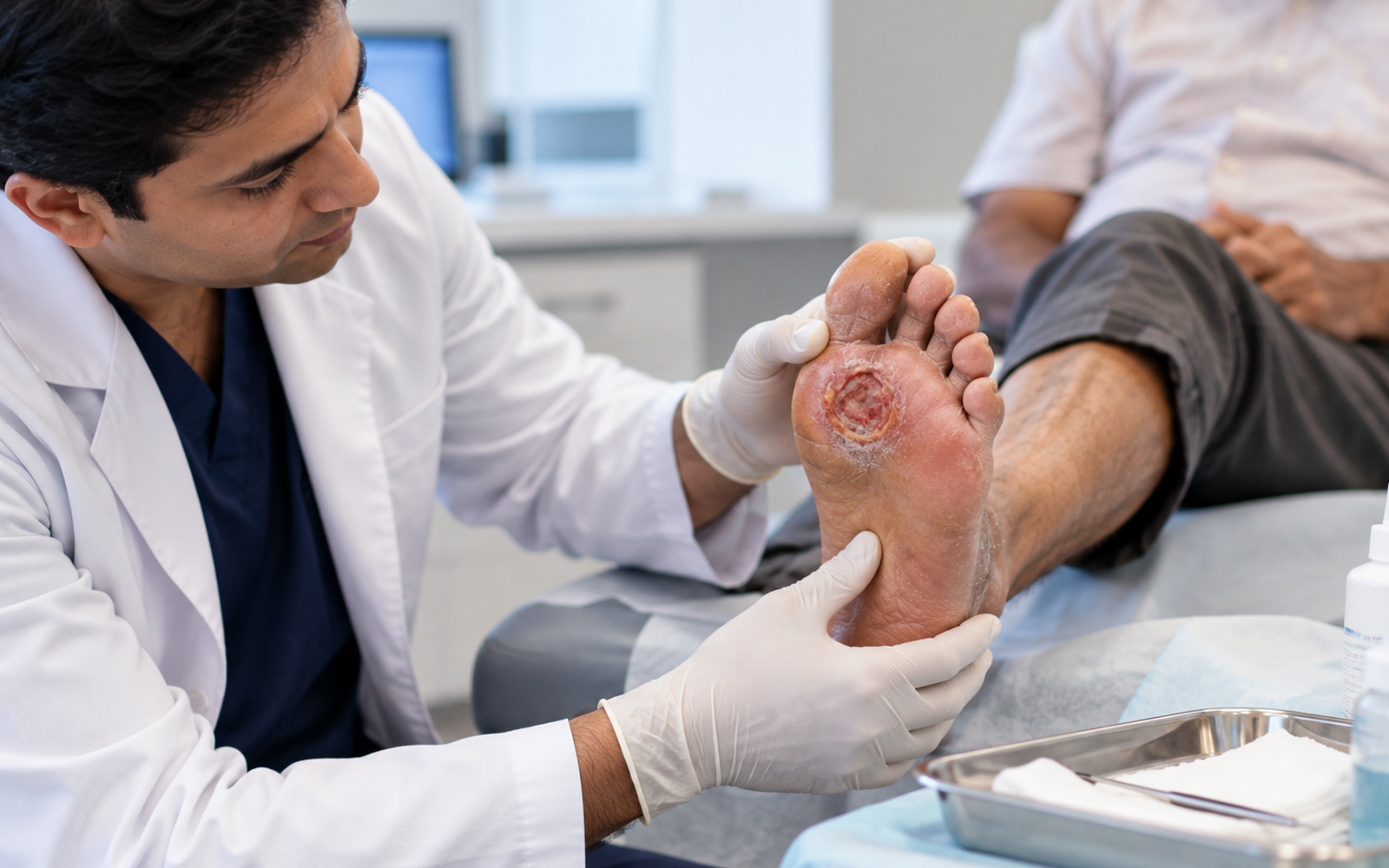
A small blister or cut on the foot may look harmless. For a person with diabetes, however, it can turn into a serious wound within days. Understanding the stages of diabetic foot ulcer helps you act early, avoid infection and protect your foot from amputation.
In this guide, we explain each stage, its warning signs and the diabetic foot ulcer treatment used at every level.
What Is a Diabetic Foot Ulcer?
A diabetic foot ulcer is an open sore or wound, usually on the sole or over a pressure point such as the big toe or heel. It affects roughly 15% of people with diabetes at some point in life.
Two main problems cause it:
- Neuropathy (nerve damage): You lose sensation, so you do not feel injuries, pressure or heat.
- Poor blood circulation: Reduced blood flow slows healing and lets infection spread quickly.
High blood sugar makes everything worse by weakening the immune response and delaying tissue repair.
Diabetes is a growing global health problem, as the WHO diabetes fact sheet explains. The International Working Group on the Diabetic Foot (IWGDF) also publishes global guidelines on preventing and managing foot ulcers.
How Are Diabetic Foot Ulcers Classified?
Doctors commonly use the Wagner classification, which grades ulcers by depth and severity. For easy understanding, we describe it here in four main stages, followed by a note on the most advanced level.
Stage 1: Superficial Ulcer
What it looks like: A shallow wound that affects only the top layer of skin. There is no deep tissue involvement and usually no infection. It often starts under a callus, blister or area of repeated pressure.
Warning signs:
- Small open sore or skin break
- Redness around the area
- Mild or no pain (because of neuropathy)
Treatment:
- Wound cleaning and dressing: Regular cleaning with saline and appropriate moist dressings.
- Offloading: Special footwear, insoles or a total contact cast to take pressure off the ulcer. This is the single most important step.
- Callus removal: A doctor safely trims dead, hard skin.
- Blood sugar control: Keeping glucose in range speeds healing.
Stage 2: Deep Ulcer
What it looks like: The wound extends deeper through the skin into fat, tendon or joint capsule, but there is no bone involvement and no abscess.
Warning signs:
- A visible crater-like wound
- Fluid or drainage
- Swelling, warmth or a foul smell
Treatment:
- Sharp debridement: Removing dead and unhealthy tissue so healthy tissue can grow.
- Advanced dressings: Foam, hydrogel, silver or collagen dressings, chosen by wound type.
- Antibiotics if needed: Based on the doctor's assessment and culture reports.
- Strict offloading and rest: Continued pressure relief is essential.
- Vascular assessment: A Doppler test checks whether blood flow is enough for healing.
Stage 3: Ulcer With Deep Infection (Abscess or Osteomyelitis)
What it looks like: The ulcer is deep and infected. There may be a pus collection (abscess), infection of the bone (osteomyelitis) or infection along the tendons.
Warning signs:
- Severe swelling and redness spreading up the foot
- Pus discharge and strong odour
- Fever, chills or unusually high blood sugar
- Exposed or "probe-to-bone" wound
Treatment:
- Hospital admission: Intravenous antibiotics and close monitoring.
- Surgical drainage and debridement: Pus and infected tissue are removed urgently.
- Bone resection: Infected bone may need to be removed.
- Imaging: X-ray or MRI to see how far the infection has spread.
- Insulin therapy: Often needed to bring blood sugar under control quickly.
Stage 4: Localized Gangrene
What it looks like: Tissue death (gangrene) in part of the foot, such as the toes or forefoot. The area turns black, dry or moist, and has no feeling. This happens when blood supply is severely blocked, often along with infection.
Warning signs:
- Black or dark discolouration of toes or skin
- Cold, pale foot with no pulse
- Severe pain or complete numbness
- Foul-smelling discharge
Treatment:
- Revascularization: Angioplasty, stenting or bypass surgery to restore blood flow, done by a vascular specialist wherever possible.
- Surgical removal of dead tissue: Removing the gangrenous part, ranging from a toe to a partial foot procedure.
- Infection control: Strong antibiotics and wound management.
- Reconstruction: Skin grafts or flap surgery once the wound is clean.
Prompt treatment at this stage can still save the rest of the foot and often the whole limb. Our specialist offers advanced diabetic foot care and limb salvage treatment to help patients avoid amputation.
When Should You See a Doctor?
Visit a diabetic foot specialist immediately if you notice:
- Any wound that does not heal in 1 to 2 weeks
- Redness, swelling or warmth in the foot
- Pus, bad smell or drainage
- Black skin or discolouration
- Numbness, tingling or burning in the feet
Never wait or try home remedies on a diabetic wound.
You can book an appointment with Dr. Harsh Vyas , for a complete foot examination and wound assessment.
How to Prevent Diabetic Foot Ulcers
Prevention is far easier than treatment. Follow these habits daily:
- Inspect your feet every day, including the soles and between the toes. Use a mirror or ask family to help.
- Wash and dry your feet gently, especially between the toes.
- Moisturize dry skin, but not between the toes.
- Wear proper footwear and clean cotton socks. Never walk barefoot, even at home.
- Cut nails straight and avoid cutting corns or calluses yourself.
- Control blood sugar, blood pressure and cholesterol.
- Quit smoking, as it reduces blood flow to the feet.
- Get a yearly foot check-up with a specialist, or more often if you have neuropathy.
Every diabetic foot ulcer starts small. The difference between a healed wound and an amputation is often how early treatment begins. Learn the stages, check your feet daily and do not ignore even a minor sore.